

" If he hadn't ordered those eggs that way, you wouldn't be guilty of involuntary manslaughter." -- Jeff Greene
Emmy nominations were announced last week and Curb Your Enthusiasm was nominated for a few, including best comedy series. Larry David was also nominated for best lead actor in a comedy for playing an extreme, misanthropic version of himself. I think Larry David is a comic genius and I LOVE Curb Your Enthusiasm! I can't believe it took me so long to watch, but I finally caught it this winter thanks to an HBO promotion. After watching the seventh season featuring the Seinfeld reunion, I went back and Netflixed the first six. So amazingly funny!
The Black Swan
In addition to Curb's usual debates regarding the necessity of various social conventions (like tipping policies, cell phone use, and introducing two strangers), the 7th episode of the 7th Season "The Black Swan" gives us the opportunity to examine criminal and tort liability in the context of the "eggshell skull" doctrine.

Larry and his entourage are out for a morning of golf and thoroughly annoyed to be stuck waiting behind a guy named Norm, who is known as the slowest golfer in the club. Their attempt to beat the slow foursome out onto the course was foiled by Larry's cousin Andy, who insisted on ordering eggs with crispy onions at breakfast.

Finally Larry can't take it anymore and starts yelling at Norm, "You can't hold up the whole course like this! It's very inconsiderate!" And, when Norm asks about Larry's wife (who has recently left him), he retorts, "F--- you, Norm!" In the locker room after the game, one of Norm's golfing companions asks Larry why he had to yell and scream at Norm, especially given that he has high blood pressure. "You know what happens when you yell at someone who has high blood pressure? They have a heart attack and they die, and that's exactly what happened. Norm is dead!"
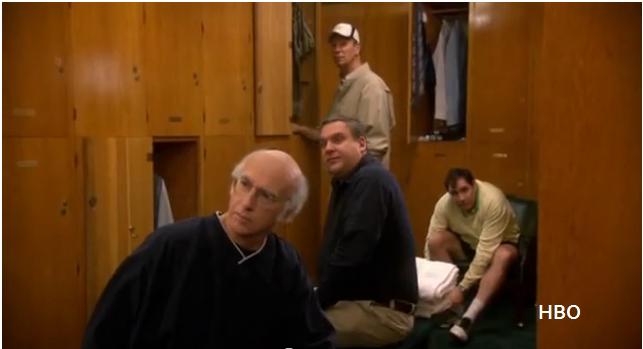
Larry's friend Marty Funkhouser shakes his head and says, "Look it may have been an accident, but you're a murderer." His manager Jeff reassures him by saying that it's just involuntary manslaughter because he didn't intend to kill Norm. Larry exclaims, "You're blaming me? It's not my fault he had a heart attack!" Well, who is right?
Murder
For Larry to be guilty of murder, he must have killed Norm with one of the following states of mind: (1) intent to kill, (2) intent to inflict great bodily injury, or (3) reckless indifference to an unjustifiably high risk to human life (also known as "abandoned and malignant heart.") Larry's conduct must also be both the "cause-in-fact" and the proximate cause of Norm's death. That is, the prosecution would have to show that Norm would not have died "but for" Larry's yelling and that Norm's death was a natural and probable consequence of Larry's behavior, even if Larry did not anticipate the result. The general maxim is that criminal defendants must "take their victims as they find them," meaning that the victim's preexisting weakness or fragility will not break the chain of causation, even if the result was utterly unforeseeable. Thus, the fact that Larry did not know that Norm had high blood pressure does not help him here. And, it seems that there is a good argument that causation exists here. However, I think it is clear that Larry had neither the intent to kill Norm or inflict great bodily injury upon him. Although many people in Larry's inner circle might describe him as having an "abandoned and malignant heart," that doctrine typically refers to things like driving a car onto a crowded sidewalk and would probably not extend to yelling at a slowpoke on a golf course.
Involuntary Manslaughter
If Larry is not guilty of murder, is Jeff right that he is guilty of involuntary manslaughter instead? Involuntary manslaughter is an unintentional killing resulting without malice aforethought caused by criminal negligence. Criminal negligence means that Larry's conduct must have created a high degree of risk of death or serious injury, well beyond the tort standard of ordinary negligence. Again, it must be particularly egregious behavior and I doubt reaming out Norm would qualify.
Tort Liability
Even though Larry will likely avoid criminal charges, it is worth examining whether Norm's next of kin would be able to sue Larry with a wrongful death claim. Similar to the "take your victim as you find him" rule in criminal law, the "eggshell skull" doctrine in torts holds the defendant liable for all consequences resulting from tortious or negligent activities that lead to an injury, even if the victim suffers an unusually high level of damage. An example is a case out of Wisconsin where a boy lightly kicked the shin of a schoolmate, who unbeknown to him was recovering from another injury and wound up losing all use of that leg as a result of the kick. Even though that level of injury could not have been predicted, the court held the boy liable for the entirety of the harm because the kick was unlawful.
Physical Contact Not Required
Physical contact is not required for the eggshell skull doctrine to apply. For example, if a tresspasser's wrongful presence on someone's property is so terrifying that the property owner has a heart attack, the tresspasser would be liable. But even though no physical contact is required, there still must be an underlying tort for liability to exist.
Infliction of Emotional Distress
When I first watched this episode, the tort I immediately thought of was intentional (or negligent) infliction of emotional distress. Upon reviewing the elements for each, however, neither seems to apply here. Those torts focus on compensating the victim for emotional trauma suffered due to defendant's conduct rather than compensation for a physical injury that occurred. Whatever emotional distress Norm may have suffered, presumably the bigger issue for his family is the fact that he suffered a heart attack and died. (I'm a lawyer not a doctor, but I'm gonna assume that counts as a physical injury).
Assault
Norm's family could try to claim that Larry committed the tort of assault. As discussed here, the elements of assault are: (1) an act by defendant creating a reasonable apprehension in plaintiff, (2) of immediate harmful or offensive contact to plaintiff's person, (3) intent, and (4) causation. Although Larry was yelling at Norm while holding up his golf club, he was about 20 - 30 feet away from him the entire time. Therefore, I think it would be a stretch to argue that it was reasonable for Norm to be apprehensive that Larry would contact him in a harmful or offensive way.

Larry's cousin Andy actually has a much better chance at suing Larry for assault. After yelling at Norm, Larry chases after Andy, shaking his club and yelling at him in that perfect Larry David way, "Are you happy you had the onions? Crispy onions! They have to be crispy! I can't eat breakfast unless I have crispy onions!"

The lesson seems to be this: beware of victims that might have a skull like an eggshell and beware of ordering eggs with crispy onions.


